Culture
Harvest Season in Oxfordshire — and What Operators Can Learn About Readiness
Late July turns Oxfordshire fields gold. From Microcorem’s studio here, harvest season is a grounded metaphor for operating cadence, readiness before harder months, and platforms that hold through seasons of demand — without inventing farm clients or harvest metrics.
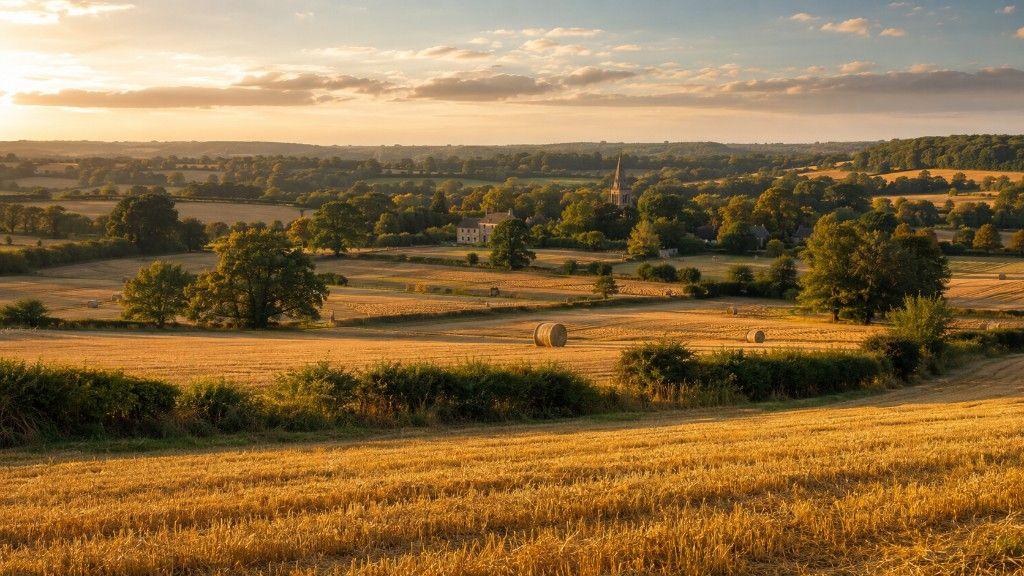
Walk a late-July lane in Oxfordshire and the landscape tells a clear story: cut stubble, round bales staged across the slope, a church spire above the trees, and light that turns the fields amber before evening. Microcorem’s studio is rooted in this county — our homepage says so plainly under “Our studio.” That rootedness is not a farming pitch. It is a place fact. Harvest season is useful to us as operators because it makes cadence visible: work that must finish while the weather holds, stores that must be ready before winter, and land that is stewarded across years — not improvised in one sunny afternoon.
What late-summer harvest actually looks like here
In this part of England, late July and early August are often when cereal harvest gathers pace. Fields go from standing crop to golden stubble. Straw is baled and left in clean rows. Villages sit in the middle of it — stone, tree cover, a spire that has watched many seasons. The photograph on this article is that scene: not a product shot, not a client farm, and not a claim that Microcorem runs agricultural programmes. It is local weather and local land, used honestly as an editorial frame.
Place-rooted Insights work when they stay accurate. We are not inventing yields, acreage, or testimonials from growers. We are noticing what any careful observer sees at this time of year — and asking what operators can borrow from it.
Seasonal cadence is an operating skill
Harvest is not a vibe. It is a calendar with constraints. Miss the window and the crop suffers. Rush without preparation and quality drops. Good seasons look calm from the road because the hard work — readiness, sequencing, storage, and stewardship — happened before the combine arrived. Digital operations have the same shape. Commerce peaks, board cycles, release windows, and winter demand do not wait for a team that “will sort the platform later.”
Microcorem builds product systems, AI-ready operations, and platforms meant to hold through those seasons of demand. The harvest metaphor is about rhythm: discovery before heavy build, environments before launch pressure, handover before the people who know the system walk into the next sprint. Cadence is not a soft word. It is how you avoid heroic rescue every autumn.
Readiness before winter: what operators can steal from the field
After harvest comes storage, maintenance, and the quieter work that makes the next year possible. Operators know the equivalent: consolidate what shipped, close known gaps, and stop treating every ticket as equal when winter pressure is coming. Readiness is not a slide. It is whether inventory truth, checkout paths, exception dashboards, and access control will hold when volume or scrutiny rises.
A practical translation for product and platform teams:
- Name the next hard season — peak commerce, audit, winter ops, or a public launch — and date it honestly.
- Ask what must already be “in the barn”: environments, ownership, data freshness, and a path operators can run without the original builders on call.
- Prefer fewer systems that hold over more tools that only look busy in good weather.
- Treat stewardship as ongoing: patches, monitoring, and clear handovers beat one dramatic harvest moment.
Stewardship of land, stewardship of systems
Farming languages of stewardship — care across seasons, not extraction in one pass — map cleanly onto systems work. A platform that only looks good at launch and then drifts is the digital equivalent of taking a crop and neglecting the soil. Microcorem’s delivery bias is toward governed product engineering: AI-ready operations, commerce and workflow platforms, and operational intelligence that stay trustworthy after the first release.
That does not mean every engagement is “seasonal strategy,” and it does not mean we claim farm-sector expertise we do not have. It means we take local place seriously as grounding, and we take long-lived systems seriously as craft. The land metaphor stays editorial. The work stays product engineering for operators.
What this means for Microcorem
Microcorem is an Oxfordshire-based product engineering studio for AI-ready business operations. Late-summer harvest is a reminder we live beside: prepare in the window you have, stage what winter will need, and build platforms that hold through seasons of demand — not just through a launch week. The golden fields in this Insight are atmosphere and metaphor. They are not a farm case study, a harvest KPI dashboard, or an invented client story.
A short readiness checklist for operators
Before you treat the next quarter as “business as usual,” ask:
- What is our next hard season — and is readiness owned, or assumed?
- Which systems must hold under peak demand without heroic weekends?
- Where is stewardship thin: monitoring, ownership, data freshness, handover?
- Would a sceptical operator trust this platform after the golden light fades?
Build Your First Reliable AI Agent System
Move beyond AI experiments. Microcorem helps organisations design agentic workflows, retrieval systems, evaluation pipelines, and production-ready LLM applications.