
The best use of an LLM in a small manufacturing company may not be answering questions. It may be moving the right information between existing systems before somebody has to ask for it.
Imagine a small manufacturing company based in Berkshire.
The company already has software.
Customer relationships are managed in a CRM.
Accounts are handled through Xero or another finance system.
Production orders, stock and purchasing are managed through an ERP or manufacturing system.
Documents are stored in SharePoint.
Staff communicate through Outlook and Microsoft Teams.
So the problem is not that the company has no technology.
The problem is what happens between those systems.
A customer asks for a quotation
An existing customer sends an email:
“Can you manufacture 250 of these components for delivery during the second week of October? We have attached the revised specification.”
Several things now have to happen.
Someone reads the email.
They open the attachment.
They check whether this is an existing part.
They find the customer's previous orders and quotations.
They check material availability.
They check production capacity.
Someone may ask purchasing for an updated material cost.
A price is calculated.
The quotation is prepared.
The CRM is updated.
The quotation is finally emailed back to the customer.
None of these individual jobs is particularly difficult.
The problem is that the information required to create the quotation is spread across several systems — and often across several people.
This is where an LLM can become useful
An LLM — a Large Language Model — is the underlying technology behind tools such as ChatGPT.
But in a business workflow, the LLM does not need to sit in a chat window waiting for somebody to ask it a question.
It can work behind the scenes.
When the customer's email arrives, an AI workflow can read it and extract the important information.
For example:
✓ Customer: Berkshire Engineering Ltd
✓ Part: BRK-442 housing
✓ Quantity: 250
✓ Required date: 12 October
✓ New drawing attached: Yes
✓ Request: Revised quotation
The information is now structured so that other systems can use it.
Step 1 — Classification
The first task for the AI is relatively simple.
It works out what kind of message has arrived.
Is it a new quotation request?
An existing-order enquiry?
A quality complaint?
A delivery question?
Or a supplier message?
This is called classification.
Instead of somebody manually reading and routing every message, the system can classify the enquiry and start the appropriate workflow automatically.
Anything uncertain can still be sent to a person.
Step 2 — Finding the right previous information
The customer may have ordered something similar eighteen months ago.
There could be hundreds of previous quotations, drawings and production documents.
This is where embeddings and semantic search become useful.
Instead of searching only for an exact filename or product code, the system can search for documents that are similar in meaning.
It might find:
✓ the customer's previous quotation;
✓ an earlier version of the drawing;
✓ a similar component manufactured previously;
✓ the relevant material specification.
The employee does not have to search through folders manually.
Step 3 — Retrieval-Augmented Generation
Finding the documents is only part of the job.
The AI then needs to use them.
This is where Retrieval-Augmented Generation, usually called RAG, becomes useful.
For this manufacturer, the system could retrieve information such as:
Previous quotation: £14.80 per unit
Previous material: 6082 aluminium
Previous quantity: 200
Last production time: 11 minutes per component
Current customer terms: 30 days
The LLM can then use this information to prepare the quotation summary.
Instead of producing a generic answer, it is working with information from the company's own documents.
Step 4 — Ask the business systems for today's information
Historical information is not enough.
The company also needs to know what is happening now.
The AI workflow could ask the ERP system:
Do we have enough material?
What is the current material cost?
How much production capacity is available?
What is the expected manufacturing lead time?
It could ask the CRM:
Is this an existing customer?
Who manages the account?
What previous quotations are still open?
And it could ask the finance system:
Is the customer account in good standing?
The LLM is not inventing these answers.
It is requesting them from the systems that already hold the information.
Step 5 — Structured output and function calling
Modern LLMs do not have to return a long paragraph of text.
Their output can be structured into specific fields that software can use.
For example:
Customer ID: 8837
Part: BRK-442
Quantity: 250
Estimated material cost: £1,825
Estimated production hours: 46
Proposed unit price: £16.40
Earliest delivery: 9 October
Confidence: Requires commercial approval
The automation can then use those fields inside other business systems.
This is often referred to as structured output or function calling.
This is one of the major differences between using AI by itself and embedding AI into a real business process.
Step 6 — The quotation is prepared, not automatically approved
This is where automation needs discipline.
The system could prepare:
✓ the quotation;
✓ the pricing calculation;
✓ a summary of the previous order;
✓ current production availability;
✓ the customer's previous terms;
✓ any important differences between the old and new drawing.
It could then send a Microsoft Teams notification to the sales or production manager:
Quotation ready for review.
The manager reviews the important information and approves it.
The AI has removed much of the preparation work.
It has not removed commercial responsibility.
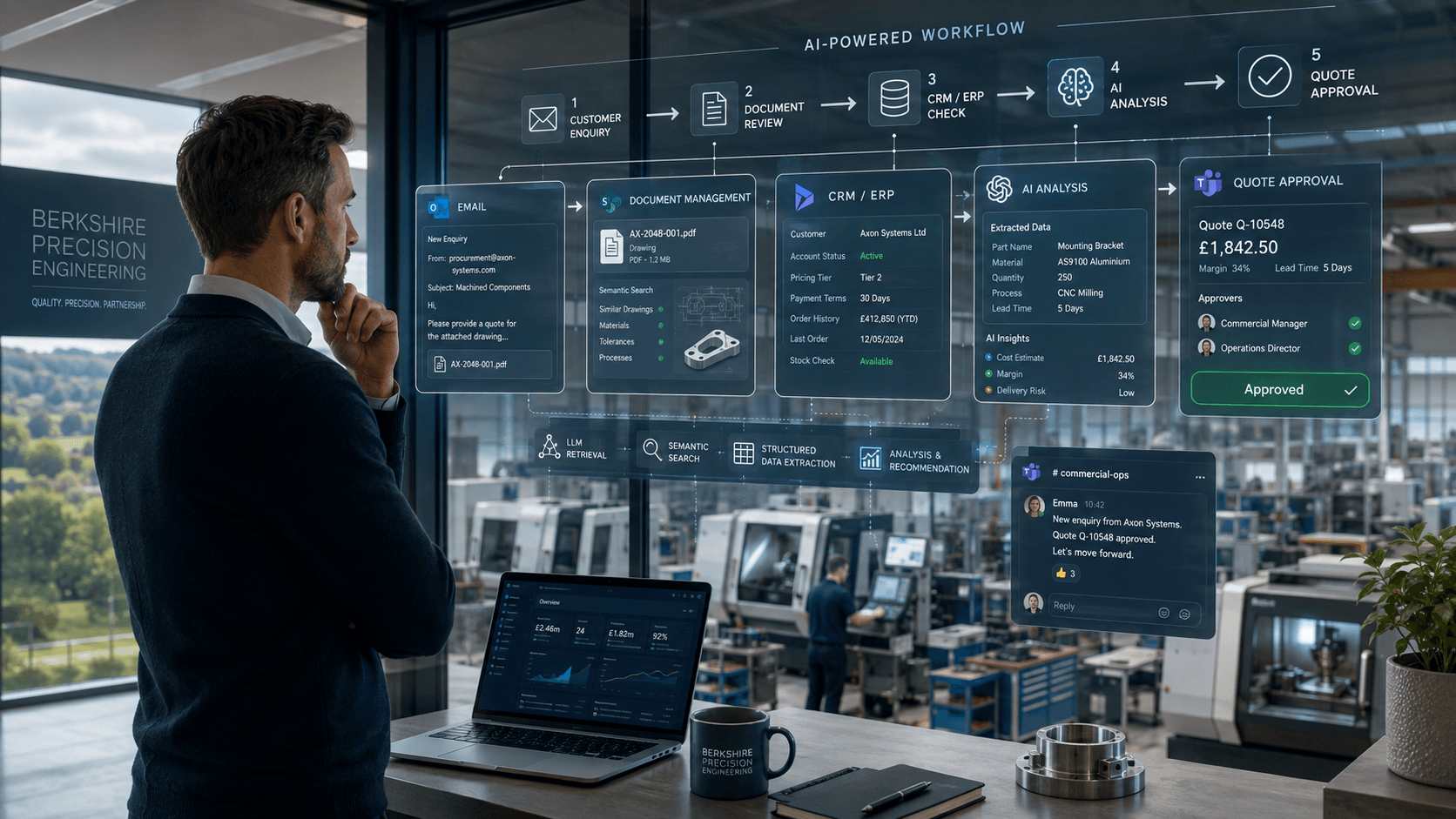
A workflow across several existing platforms
A practical workflow could look like this:
Outlook
Customer enquiry arrives.
LLM classification and document extraction
Customer, product, quantity and deadline are identified.
SharePoint + semantic search
Previous quotations, drawings and specifications are found.
RAG
The LLM uses the relevant company documents to understand the history of the request.
ERP / Manufacturing System
Stock, materials, production capacity and lead time are checked.
CRM — for example HubSpot
Customer history, opportunities and account ownership are retrieved.
LLM structured output
Quotation information and a recommended response are prepared.
Microsoft Teams
The manager receives an approval request.
CRM + SharePoint + Outlook
The approved quotation is recorded and sent.
The existing systems remain.
The information is moved between them.
AI carries out much of the repetitive preparation work.
The important point is not the LLM itself
Businesses can easily become distracted by questions such as:
Should we use GPT, Claude or another model?
The choice of model matters.
But it is rarely the first business question.
The more important questions are:
Where is the information now?
Which systems need to communicate?
Which decisions can safely be prepared automatically?
Which decisions still require a person?
How do we stop incorrect information from progressing through the workflow?
That is the real engineering work.
What happens when something is unusual?
Suppose the AI notices that the new drawing is significantly different from the previous version.
It should not quietly create a quotation based on the old manufacturing process.
Instead it can produce a warning:
Engineering review required — drawing revision appears to include dimensional changes affecting the previous process assumptions.
That is a useful business signal.
The system knows when the workflow should stop and involve somebody.
Good automation is not simply about making processes faster.
It also needs to know when not to automate.
The benefit for a small manufacturer
A company with around 30 employees probably does not want another huge software project.
It simply wants the systems it already uses to work better together.
The employee can then spend more time deciding:
Should we take this order?
Can we deliver it profitably?
What price should we offer?
rather than:
Where is the information I need?
That is where AI automation becomes useful.
It reduces the time spent collecting and preparing information, while keeping the important decisions with the people who understand the business.
Key Takeaway
A small manufacturer does not need to replace its people or its existing software to use AI.
A far more practical approach is to connect the systems it already has and use an LLM to automate the repetitive work between them.
Email → documents → CRM → ERP → pricing → approval → quotation
The LLM helps understand and prepare the information.
The company's existing systems provide the facts.
The employee remains responsible for the important decision.
Next Step
Microcorem helps businesses identify practical AI automation opportunities across existing software rather than replacing systems that already work.
For a small manufacturer, a useful first project could be one high-friction workflow:
customer enquiry → technical review → stock and capacity check → quotation → approval
Once that process is working reliably, the same approach can be extended into purchasing, production planning, customer service and supplier management.