LLM Engineering

A practical guide to the architecture behind useful LLM products, covering user experience, grounding, orchestration, evaluation, monitoring, security, and governance.
Large language models have made it much easier to prototype AI features. A team can connect a model, write a prompt, test a few examples, and produce something that feels impressive in a demo. But that early success can create a misleading impression: that building useful LLM applications is mainly about writing better prompts.
Prompt quality matters. It affects tone, structure, reasoning style, and consistency. But prompt engineering is only one part of a much larger product and engineering challenge. Once an organisation wants an LLM application that works reliably for customers, employees, or operational teams, the real work becomes system design.
A production LLM application needs data access, retrieval, workflow orchestration, evaluation, monitoring, permissions, fallback logic, and a clear user experience. Without these layers, the result is usually a clever assistant that works in isolated examples but fails when exposed to real business complexity.
The difference between a demo and a dependable AI product is not the prompt. It is the architecture around the model.
Why prompts are not enough
A prompt can guide a model, but it cannot solve every operational problem.
It cannot guarantee that the model has access to the right business data. It cannot verify whether a response is accurate. It cannot decide which system should be queried. It cannot understand user permissions unless those permissions are built into the application. It cannot monitor failures, control costs, or create an audit trail.
In a business environment, those issues matter more than phrasing. A customer-support assistant that gives confident but incorrect answers can damage trust. An internal AI tool that ignores permissions can expose sensitive information. A workflow assistant that cannot distinguish between a draft and an approved action can create operational risk.
This is why businesses need to think beyond prompts and design LLM applications as real software systems.
The architecture behind useful LLM products
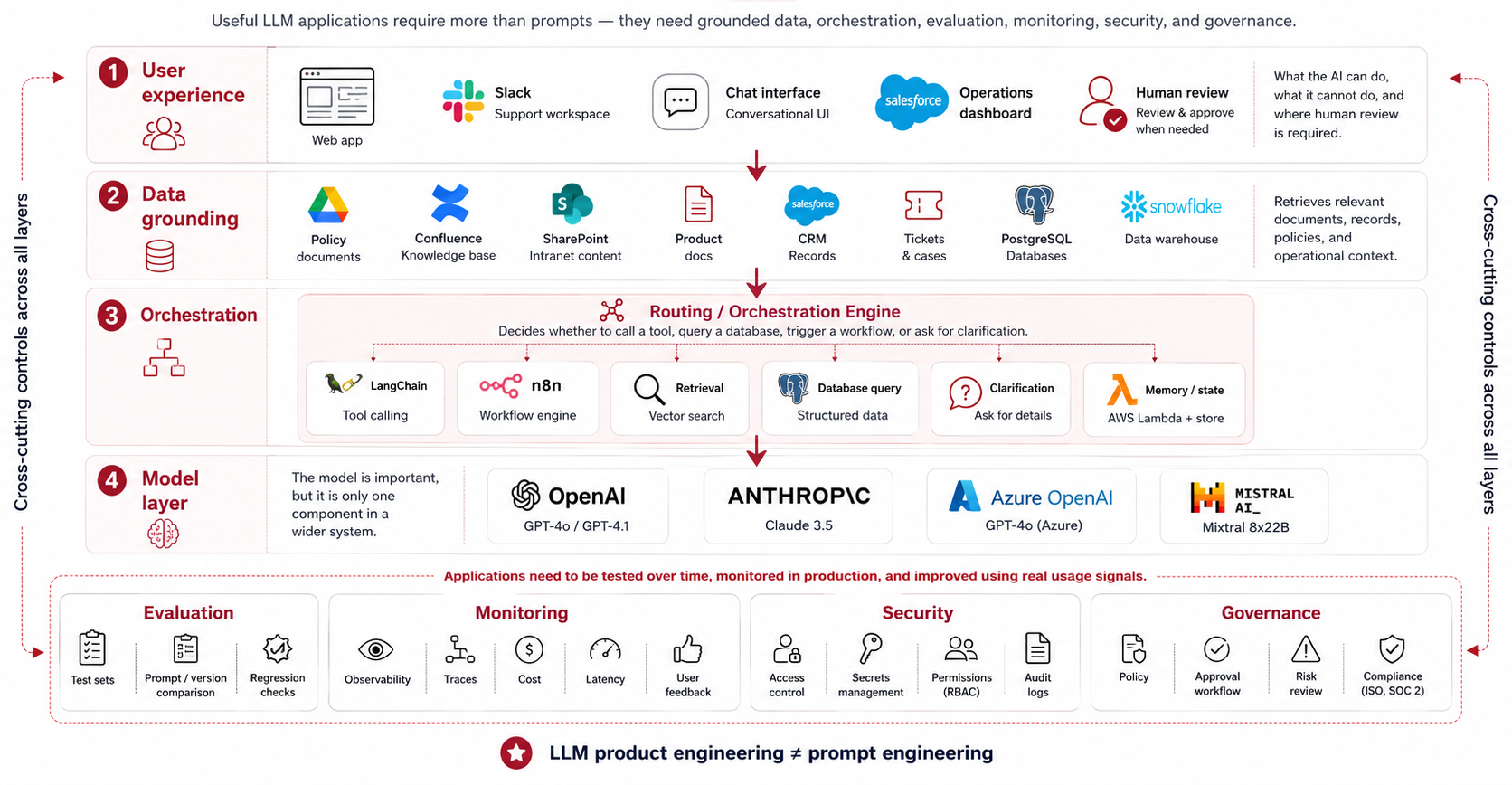
A serious LLM application usually has several layers.
The first layer is the user experience. Users need to understand what the AI can do, what it cannot do, and where human review is required. The second layer is data grounding, where the system retrieves relevant documents, records, policies, or operational context. The third layer is orchestration, which decides whether to call a tool, query a database, trigger a workflow, or ask for clarification.
Beyond those layers, the application needs evaluation, monitoring, security, and governance. It needs to be tested over time, not only demonstrated once. It needs to improve based on real usage, not assumptions.
This is where LLM product engineering becomes different from prompt engineering. The model is important, but it is only one component in a wider system.
Retrieval and context design
Most business LLM applications need access to company-specific knowledge.
That may include product documentation, customer records, operational policies, internal playbooks, technical manuals, case notes, or compliance guidance. The model alone does not know this information unless it is provided at the right time and in the right form.
Retrieval-augmented generation, often called RAG, is one common way to solve this. But effective retrieval is not just about putting documents into a vector database. The system needs clean content, useful metadata, sensible chunking, ranking logic, source visibility, and fallback behaviour when the answer is not available.
Good context design helps the AI answer from evidence rather than assumption. It also helps users trust the result because they can see where the answer came from.
Tool calling and workflow orchestration
Useful LLM applications often need to do more than produce text.
They may need to search a knowledge base, check an order, update a record, create a ticket, summarise a meeting, prepare a report, or pass a task to a human reviewer. That requires tool calling and workflow orchestration.
The application needs to know when to call a tool, which tool to call, what data to send, and whether the action should be automatic or require approval. It also needs guardrails so that the system does not take actions beyond its authority.
For SaaS products, this is especially important. The most valuable AI features are often not chat interfaces. They are embedded workflows that reduce manual work, improve decisions, and help users complete complex tasks faster.
Evaluation and testing
LLM systems cannot be tested in exactly the same way as traditional deterministic software, but they still need structured testing.
A production application should be evaluated against real examples, edge cases, unacceptable outputs, hallucination risks, source-grounding quality, and user intent. Teams should check whether the answer is useful, accurate, safe, and appropriate for the workflow.
This requires test datasets, review processes, regression checks, and feedback loops. Without evaluation, teams cannot tell whether changes to prompts, models, retrieval logic, or workflows are improving the product or making it less reliable.
Evaluation turns AI development from guesswork into an engineering discipline.
Monitoring, observability, and feedback
Once an LLM application is live, the system needs to be observed.
Teams need to understand what users ask, where the system fails, which sources are used, how often fallbacks are triggered, how much the system costs to run, and whether users trust the output. They also need to identify patterns: repeated unanswered questions, poor retrieval results, slow responses, or risky behaviours.
This is where observability becomes essential. Logs, traces, analytics, user feedback, and quality signals help teams operate the application in the real world.
A reliable LLM product is not simply launched. It is monitored, adjusted, and improved continuously.
Security and governance
LLM applications must respect business rules.
A user should not receive information they are not allowed to access. A model should not expose private data because it appeared in retrieved content. A workflow should not trigger sensitive actions without approval. A system should not silently make decisions that require human oversight.
Security and governance need to be designed from the beginning. This includes authentication, authorisation, permission-aware retrieval, audit logs, safe tool access, prompt-injection protection, and clear escalation paths.
For organisations working in regulated or high-trust environments, this is not optional. It is part of making AI usable in practice.
How Microcorem approaches LLM product engineering
Microcorem treats LLM applications as product infrastructure, not isolated experiments.
The starting point is not the model. The starting point is the workflow: what users need to achieve, where they lose time, what information they need, what decisions they make, and where automation can safely help.
From there, the system can be designed around the right data layer, integration points, user experience, evaluation process, and governance model. The prompt becomes one part of a wider architecture rather than the centre of the product.
This approach is especially important for SaaS products, operational platforms, commerce systems, and healthcare infrastructure tools where reliability, traceability, and user trust matter.
Where businesses should start
The best starting point is a focused workflow, not a broad AI transformation programme.
Choose one process where users already spend time searching, summarising, comparing, drafting, checking, or coordinating between systems. Define what good output looks like. Identify the data sources. Decide what the AI is allowed to do. Decide where human review is required. Then build a small but real prototype that can be tested with actual users.
This reduces risk and makes the opportunity measurable.
A well-scoped LLM application can show whether AI will improve a workflow before the organisation invests in a larger platform.
Conclusion
Building LLM applications is not prompt engineering. Prompting is part of the interface between the user, the system, and the model. But the real product value comes from everything around it: retrieval, context, orchestration, evaluation, monitoring, security, governance, and user experience.
The organisations that benefit most from LLMs will be the ones that build reliable systems rather than isolated demos.
Microcorem helps teams move from AI experiments to practical AI-enabled products: grounded in data, integrated into workflows, tested for reliability, and designed for real business use.
LLM Product Architecture Checklist
- Retrieval
- Context design
- Tool calling
- Evaluation
- Observability
- Fallback logic
- Governance
- User experience
Read next
The AI Agent Operating Layer: What Every Company Will Need Next
Understand the operating layer companies need for agents, permissions, memory, approvals, and monitoring.
Continue readingDesign production-ready LLM applications
Microcorem helps teams move from AI demos to reliable LLM products with data grounding, workflow integration, evaluation, and governance.
Plan an LLM product architecture