Platform Engineering
Data Is Your Business. Protect It.
Data is your business — protect it. Enterprise cyber security brief on confidentiality, integrity, availability, accountability, encryption, detection, access control, audit and resilient operations.
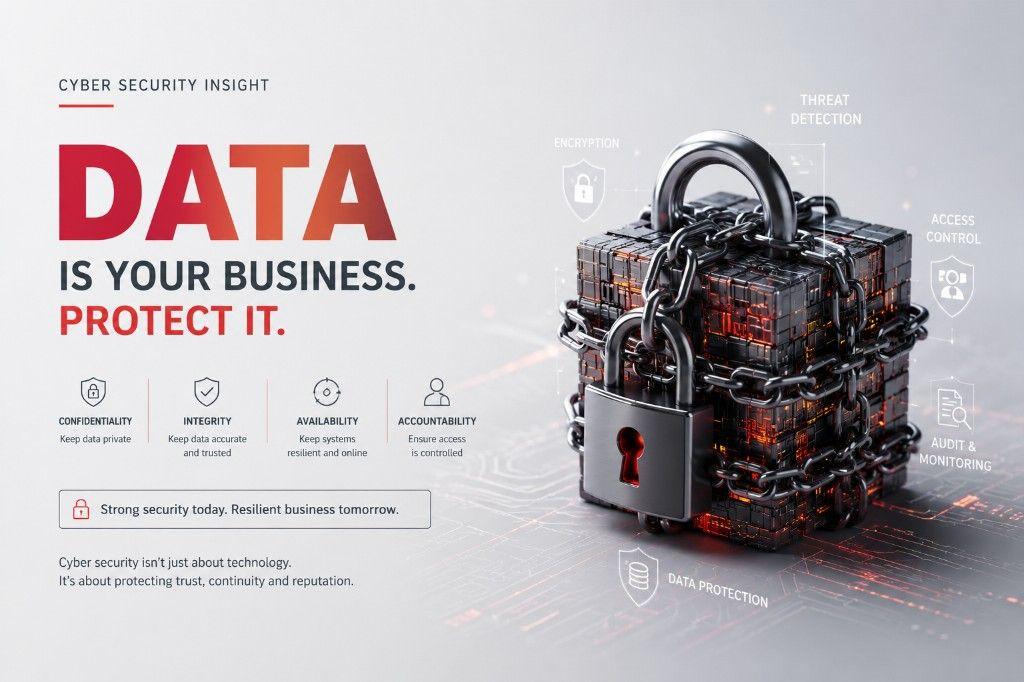
Every organisation that trades, cares for people, settles payments or runs public services is a data business — whether or not it markets itself that way. Orders, identities, clinical notes, property records, supplier contracts and operational telemetry are not side effects of software. They are the assets that make the organisation workable. When those assets are exposed, corrupted or unavailable, the failure is not “an IT incident.” It is a business failure with customers, regulators and boards asking the same questions: can we still operate, can we still be trusted, and who owned the control that failed?
Why data protection is a business issue
Boards still sometimes hear cyber security framed as a specialist cost centre: firewalls, patches, tools and compliance attestations. That framing understates the commercial reality. Customer trust is priced into every renewal and every partnership. Continuity determines whether peak season, a clinical pathway or a settlement window survives disruption. Reputation determines whether a breach becomes a contained operational event or a lasting brand and regulatory scar.
Consider a mid-market retailer whose promotions engine is compromised. The technical story may be a stolen API key or an unpatched dependency. The business story is cancelled campaigns, refund queues, payment-provider scrutiny and a partnership conversation that suddenly hinges on evidence of control. Or take a healthcare operator whose scheduling and records systems are encrypted by ransomware: the clinical and legal consequences arrive long before the restore completes.
This is why serious enterprises treat data protection as an operating discipline, not a procurement checklist. Controls must map to outcomes leaders recognise — fewer irreversible exposures, faster detection, clearer ownership, recoverable systems — rather than to a collage of product logos. Technology is necessary. It is not the whole argument.
Cyber security is not just about technology. It is about protecting trust, continuity and reputation. The rest of this article translates that statement into an engineering frame executives and platform leaders can use: the classic confidentiality–integrity–availability triad, strengthened with accountability, and then the practical capabilities — encryption, threat detection, access control, audit and monitoring, and data protection — that make the frame real.
Confidentiality, integrity, availability and accountability
The CIA triad remains useful because it refuses vagueness. Confidentiality asks whether only authorised parties can see sensitive data. Integrity asks whether data remains accurate and trustworthy. Availability asks whether systems and data remain usable when the business needs them. Accountability — the discipline many organisations now make explicit alongside the triad — asks whether access and change can be attributed to identifiable people and systems, and whether those people own the consequences.
Confidentiality failures are the breaches that dominate headlines: customer lists on the open web, credentials in a public repository, a partner feed scraped because an endpoint was left open. Integrity failures are quieter and often more damaging in operations: a silently altered price file, a corrupted clinical measurement, a finance close that no longer reconciles because a transformation rewrote history. Availability failures need no introduction — ransomware, cascading outages, a dependency that vanishes at peak load.
Accountability closes a gap the triad alone does not. You can encrypt everything and still not know who approved an exception. You can keep systems online and still not reconstruct who changed a privilege. Accountability means controlled access, retained evidence and named owners — the difference between “we have tooling” and “we can explain ourselves.”
In practice the four properties pull against each other. Heavy confidentiality controls can impede legitimate work. Aggressive availability targets can pressure teams to skip restore testing. Strong audit can create retention and privacy tensions. Leadership’s job is not to maximise every property in isolation; it is to set explicit trade-offs, fund the controls that enforce them, and refuse silent exceptions that accumulate into systemic risk.
Encryption in enterprise terms
Encryption is the practical expression of confidentiality for data at rest and in transit. In enterprise estates that means more than ticking a box on a cloud console. It means knowing which keys protect which stores, who can unwrap those keys, how rotation works, and what happens when a key is compromised. Encryption without key governance is theatre: the ciphertext may be strong while the key lives in a shared vault nobody reviews.
Transit encryption is similarly ordinary and still frequently incomplete. Internal service meshes, partner APIs and backup pipelines are where plaintext quietly reappears because “it is inside the perimeter.” Modern estates treat the perimeter as porous. Prefer authenticated encryption for sensitive paths, terminate TLS intentionally, and avoid parallel “temporary” channels that bypass corporate standards because a vendor integration was hurried.
A useful operating standard: classify data, map stores and flows, then apply encryption and key ownership accordingly. Customer payment tokens, identity secrets and regulated personal data deserve stronger key isolation than marketing analytics extracts. Assistants and automation that touch encrypted material must inherit the same key discipline — never a shared master secret pasted into a configuration file for convenience.
Threat detection that operators can act on
Threat detection is how organisations notice that confidentiality, integrity or availability is under attack before the damage is irreversible. Detection without response is a dashboard hobby. Response without detection is improvisation. Enterprise value sits in the loop: signal, triage, containment, eradication, recovery and learning — with clear ownership at each step.
Practical detection programmes start from the assets that matter: identity systems, privileged access paths, payment and case systems, data stores with regulated content, and the integration hubs that move data between them. Noise is inevitable. The discipline is to tune for high-signal events — impossible travel for privileged accounts, mass export from a sensitive store, unexpected privilege elevation, ransomware-like encryption patterns — and to give responders runbooks they have rehearsed.
Vendor tools help; they do not replace estate knowledge. A detection rule that does not understand your change windows, partner batch jobs or break-glass procedures will either drown the team or miss the real anomaly. Treat detection engineering as product work for the security operations function: backlog, owners, false-positive budgets and regular retirement of rules that no longer earn their keep.
Access control and the least-privilege habit
Access control is where confidentiality and accountability meet daily operations. Most damaging breaches still involve credentials that were too broad, too long-lived or too poorly reviewed. Least privilege is not a slogan for identity vendors; it is an engineering habit: grant the minimum role for the task, time-box elevated access, separate duties for irreversible actions, and make revocation as easy as grant.
Enterprises struggle here because access is social as well as technical. Teams share service accounts “just for the sprint.” Contractors inherit standing admin rights. Break-glass accounts become standing doors. Corrective programmes succeed when they combine identity technology with operating rules: quarterly access reviews that managers actually perform, just-in-time elevation with recorded justification, and service identities that are scoped to a workload rather than to “everything in the cluster.”
As AI assistants and agentic workflows enter production, access control becomes sharper still. Every tool call is an access event. The question is on whose behalf the action runs, which data it may see, and whether write capabilities require a human gate. If those answers are vague, you have invented a new privileged user that never sleeps and never owns a risk register entry.
Audit, monitoring and evidence you can defend
Audit and monitoring turn security from aspiration into evidence. Monitoring watches for health and anomaly in near real time. Audit preserves a reconstructable trail of who did what, to which asset, when, and under which authority. Together they support detection, incident response, compliance and the uncomfortable but necessary question after a failure: what did we know, and when?
Good audit design is selective and durable. Log privileged access, configuration changes, data exports from sensitive stores, authentication failures at critical boundaries and administrative actions in identity systems. Align retention with legal and operational need — long enough to investigate and attest, not so long that logs become an unmanaged personal-data lake. Encrypt and control access to the logs themselves; attackers who can erase the trail have already won half the battle.
Monitoring must reach beyond infrastructure metrics. Security-relevant signals include certificate expiry on critical paths, unusual API error rates after a release, backup job failures and restore-test results that nobody wants to look at. Continuity is part of the security story: availability is a CIA property, and silent backup failure is a future outage dressed as green dashboards.
Data protection as an operating practice
Data protection sits above individual controls as the organisational commitment to handle information lawfully, carefully and recoverably. In UK and European contexts that includes privacy obligations, retention limits and lawful processing. In every market it includes the engineering basics: know what you hold, know why you hold it, know who can reach it, and know how you destroy or restore it.
Practically, data protection programmes connect classification, minimisation, retention, encryption, access and incident playbooks. A store that holds more personal data than the product needs is a larger blast radius. A retention policy that is never enforced is a promise to a regulator you cannot keep. A backup that has never been restored under time pressure is a continuity claim without evidence.
Security architecture reviews — the calm, daylight work of tracing trust boundaries on paper and on screens — remain one of the highest-leverage habits. They force teams to name where untrusted input enters, where privileged actions occur, and where data leaves the organisation. That discipline does not require theatrical language. It requires time on the calendar and named owners who can reject a design that is convenient but indefensible.
Strong security today, resilient business tomorrow
Resilience is the business translation of strong security. A resilient organisation can absorb attack and failure without losing the ability to serve customers, protect people and meet obligations. That outcome is built from today’s boring choices: patched systems, tested restores, least privilege, monitored critical paths, rehearsed incident command and clear ownership maps.
Organisations that defer those choices often discover the cost during the wrong week — peak commerce, a regulatory inspection, a partner audit, or a ransomware weekend. Recovery then competes with improvisation: who has the keys, which backups are clean, which privileges were standing open, which customers must be notified. The engineering debt was always a business debt.
Investment framing helps. Encryption and key management reduce the value of stolen disks and dumps. Detection and response shorten attacker dwell time. Access control limits blast radius. Audit makes investigation and attestation possible. Data protection programmes reduce unnecessary exposure. None of these is a one-off project. Each is a capability that compounds — or decays — with every release and every exception.
Strong security today is how you buy a resilient business tomorrow. The slogan is only useful if it maps to funded owners, measurable controls and leadership willingness to slow a convenient shortcut when the residual risk is unacceptable.
Practical recommendations for enterprise leaders
Leaders do not need to become cryptographers. They need decision clarity, funding discipline and evidence standards. The following practices keep cyber security attached to business outcomes rather than to tool catalogues.
- Name business outcomes for the security programme: trust (fewer material exposures), continuity (tested recoverability), reputation (defensible evidence under scrutiny).
- Publish a short ownership map for confidentiality, integrity, availability and accountability controls — including who accepts residual risk.
- Classify critical data stores and flows; apply encryption and key ownership accordingly, with rotation and break-glass procedures that are actually tested.
- Fund detection and response as an operating capability: high-signal use cases, rehearsed playbooks, on-call that can contain as well as escalate.
- Enforce least privilege with time-boxed elevation, service identities scoped to workloads, and access reviews that managers complete.
- Treat audit logs as a protected system of record: privileged actions, exports, identity changes — retained, secured and usable in investigation.
- Require restore tests and incident tabletop exercises on a calendar, not as a slide promise after a near miss.
- Extend the same access, audit and approval discipline to AI tools and agentic workflows that can read or change business systems.
- Measure progress with operational indicators leaders recognise: mean time to contain, privileged standing access trend, restore success under time targets, exception ageing — not vanity tool coverage.
Conclusion
Data is your business. Protecting it is therefore a leadership obligation expressed through engineering: confidentiality, integrity, availability and accountability made real by encryption, detection, access control, audit, monitoring and disciplined data protection. The organisations that treat these as operating capabilities — owned, funded, tested — convert security spend into continuity and trust. The organisations that treat them as optional decoration discover, under pressure, that reputation and recoverability cannot be bought after the fact.
Keep the language practical. Keep the owners named. Keep the evidence reconstructable. Strong security today is not a marketing line. It is how a resilient business earns the right to operate tomorrow.
Build Your First Reliable AI Agent System
Move beyond AI experiments. Microcorem helps organisations design agentic workflows, retrieval systems, evaluation pipelines, and production-ready LLM applications.