
The problem is rarely that the business does not have the data. The problem is that nobody has connected the data into a signal that tells the business what to do next.
A modern business can have very good software and still have poor visibility.
The problem is easy to recognise.
The sales team works in HubSpot.
Customer-support activity sits in Zendesk.
Payments and subscriptions are processed through Stripe.
Finance, customer and operational data may be consolidated in Snowflake.
A separate ticketing system manages operational issues.
External signals may come from suppliers, the market, customer activity or social media.
Other organisations may also use Salesforce to manage customer accounts, opportunities and commercial information, or Databricks for data engineering, analytics and AI workloads.
Every platform is doing its own job.
Yet management can still ask:
What needs our attention today?
and receive six different answers.
That is the problem Enterprise Data & AI Delivery is designed to solve.
The problem is not another missing platform
Businesses often respond to fragmented information by buying another tool.
But another tool does not necessarily create a better answer.
The useful information may already exist inside the systems the company has.
Snowflake
Snowflake may contain consolidated customer, revenue, finance and operational datasets.
That information can reveal changing revenue patterns, customer segments and operational trends.
HubSpot
HubSpot can show customer engagement.
A valuable account may have stopped responding.
Marketing opt-outs may suddenly be rising.
An opportunity that had been moving quickly may have gone quiet.
Zendesk
Zendesk knows what customers are asking about and what they are complaining about.
It can show increasing ticket volumes, repeated problems or important customers requiring urgent support.
Stripe
Stripe contains another part of the customer relationship.
Payments may have failed.
Invoices may be overdue.
Subscription behaviour may have changed.
Salesforce
Where Salesforce is part of the company's systems, it may contain account relationships, opportunities, pipeline activity and commercial commitments.
Databricks
For larger analytical and AI workloads, Databricks can be used to transform and analyse information coming from several of these systems.
All of these platforms contain useful information.
The difficulty is understanding what that information means when it is considered together.
One customer can look healthy in one system and risky in another
Take a major customer account.
HubSpot shows strong historical engagement.
Salesforce shows a valuable account with several previous opportunities.
On the surface, nothing appears particularly worrying.
But the wider picture shows something different.
Zendesk has five unresolved support tickets.
Stripe shows two overdue invoices.
HubSpot shows that there has been no response to the last three communications.
Snowflake shows that monthly revenue from the customer has fallen for two consecutive months.
Each system contains a fact.
When those facts are connected, they create a signal:
Customer Health Risk — intervention required.
That is much more valuable to an executive than having to log into four different systems and work it out manually.
This is the difference between data and a signal
The individual data might be:
5 open support tickets
2 overdue invoices
14 days without engagement
Revenue down 11%
Those are measurements.
The business signal is:
Important customer showing early signs of commercial risk.
The next question becomes:
What should we do about it?
That is where an operating intelligence layer becomes useful.
What Microcorem connects
Microcorem's Enterprise Data & AI Delivery layer sits between the systems the business already uses and the people who need to make decisions.
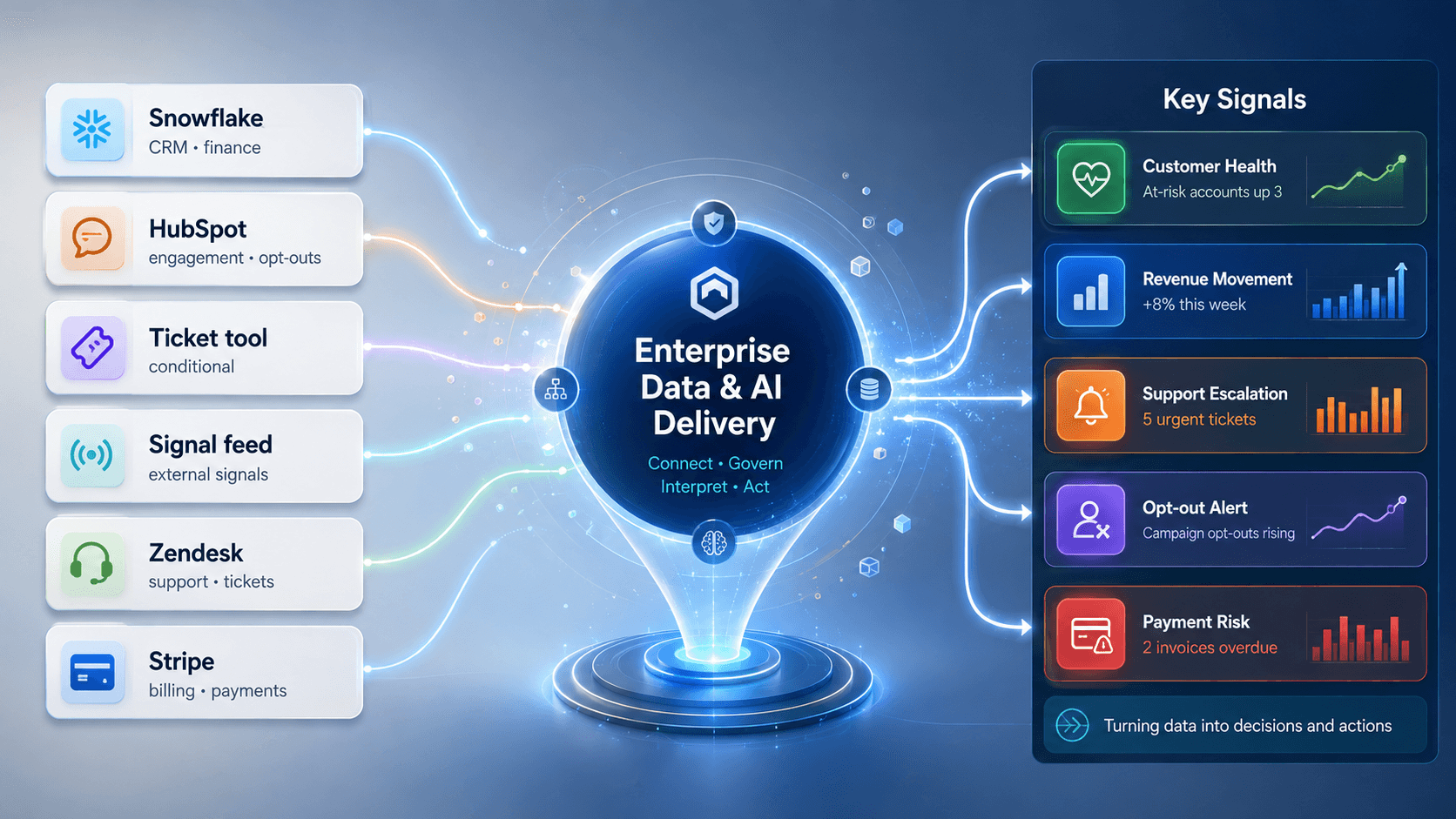
A simplified architecture might look like this:
Snowflake
customer • finance • operational data
HubSpot
engagement • campaign activity • opt-outs
Zendesk
support • tickets • escalations
Stripe
billing • payments • failed transactions
Salesforce
accounts • pipeline • opportunities
Databricks
data engineering • analytics • AI workloads
Operational and external signal feeds
suppliers • market events • internal exceptions
The information then feeds into a governed data and intelligence layer.
That layer is responsible for:
connecting
validating
governing
interpreting
and ultimately:
surfacing what requires action.
What comes out should be much simpler than what went in
A senior manager should not have to understand the structure of six different platforms.
The output might be five signals:
✓ Customer Health — Three high-value accounts have moved into an at-risk state.
✓ Revenue Movement — Revenue is 8% higher this week, driven by two customer groups.
✓ Support Escalation — Five urgent tickets are affecting strategically important accounts.
✓ Opt-out Alert — Marketing opt-outs have risen sharply following a recent campaign.
✓ Payment Risk — Two significant invoices are overdue and one account has repeated payment failures.
That is the transformation:
many systems → a few signals → clear action
The AI layer should explain, not guess
Once information from the different systems has been connected and governed, an LLM can make the operating view much more useful.
An executive could ask:
“Why is this customer marked as at risk?”
The system could retrieve the relevant governed information and answer:
The account has five unresolved support tickets, two overdue invoices, no recorded engagement for 14 days and an 11% fall in monthly revenue.
That answer comes from the company's systems.
The LLM helps retrieve, organise and explain it.
It should not manufacture the facts.
Then turn the signal into a workflow
The system should be able to do more than display a warning.
Consider the customer-health signal.
Customer risk detected
Relevant HubSpot activity is retrieved.
Zendesk support issues are checked.
Stripe payment status is checked.
Revenue movement is retrieved from Snowflake.
Account ownership is confirmed in the CRM.
AI prepares a concise account-risk summary.
The account manager receives an alert.
A person decides the appropriate action.
The signal has moved from data to understanding to action.
Governance matters before AI starts acting
Connecting enterprise systems creates as much responsibility as it does opportunity.
The system needs clear answers to questions such as:
Which data is the authoritative source?
Who is allowed to see financial information?
Can an AI assistant retrieve support conversations?
What actions can software take automatically?
Which actions require approval?
How is an automated recommendation recorded?
This is why Enterprise Data & AI Delivery is not simply an integration project.
The delivery layer must include:
✓ data ownership;
✓ permissions;
✓ auditability;
✓ validation;
✓ human control.
The result is an operating layer, not another dashboard
A dashboard displays information.
A useful Enterprise Data & AI system goes further.
It can:
✓ connect existing platforms;
✓ establish trusted definitions;
✓ detect meaningful changes;
✓ explain why a signal appeared;
✓ route the information to the right person;
✓ prepare the next action;
✓ record what happened afterwards.
That creates a closed operating loop:
Observe → Understand → Decide → Act → Measure
Clear Signals Matter More Than More Data
Rarely does simply adding more information solve the problem.
A business may already have valuable information across Snowflake, HubSpot, Zendesk, Stripe, Salesforce, Databricks and its operational systems.
The missing capability is often the layer that connects those systems and answers:
What changed?
Why does it matter?
Who needs to know?
What should happen next?
That is where data becomes operational intelligence.
Key Takeaway
Enterprise Data & AI systems are most valuable when they complement the systems a business already relies on.
The aim is not necessarily to replace Snowflake, HubSpot, Zendesk, Stripe or other existing platforms.
It is to build an intelligent operating layer across them that makes the information more useful.
Platforms provide the facts.
The data layer makes those facts dependable.
AI helps interpret them.
The workflow turns them into action.
People remain responsible for the decision.
Next Step
Microcorem's Enterprise Data & AI Delivery service helps organisations whose valuable information is distributed across platforms, teams and workflows.
We begin by identifying a high-value business decision and connecting the systems behind it.
We then establish the necessary data quality and governance before creating the operational intelligence required to detect signals and drive controlled action.
The first project does not need to connect the entire enterprise.
It can begin with one important question:
Which customers are showing signs of commercial risk before that risk appears in the monthly report?
Once that first use case is working reliably, the same architecture can expand into revenue intelligence, operations, customer service, finance, supplier risk and AI-assisted decision workflows.