

Growing ecommerce businesses are often told that the next stage of maturity is better reporting. That can be true, but many teams already have more reporting than they can use.
Shopify shows orders, revenue and conversion. Amazon shows marketplace performance. Advertising platforms show spend, ROAS and campaign movement. Analytics tools show traffic and behaviour. Inventory and fulfilment systems show what is available, delayed or at risk.
None of those dashboards are useless. The problem is that they usually stop at visibility. They show a signal, then leave the team to interpret it, compare it with other signals and decide what happens next.
The problem is interpretation, not information
A sales increase can look positive until it is compared with margin. A strong campaign can be worth scaling, or it can be quietly pushing low-margin stock. A product can appear popular while returns are rising because of sizing, quality or delivery expectations.
In many growing ecommerce businesses, those decisions still happen manually. Someone checks one platform, exports a report, asks a colleague, updates a spreadsheet, opens a task, then follows up later to see whether anything changed.
That is not a dashboard problem. It is an operating problem.
What an operating layer changes
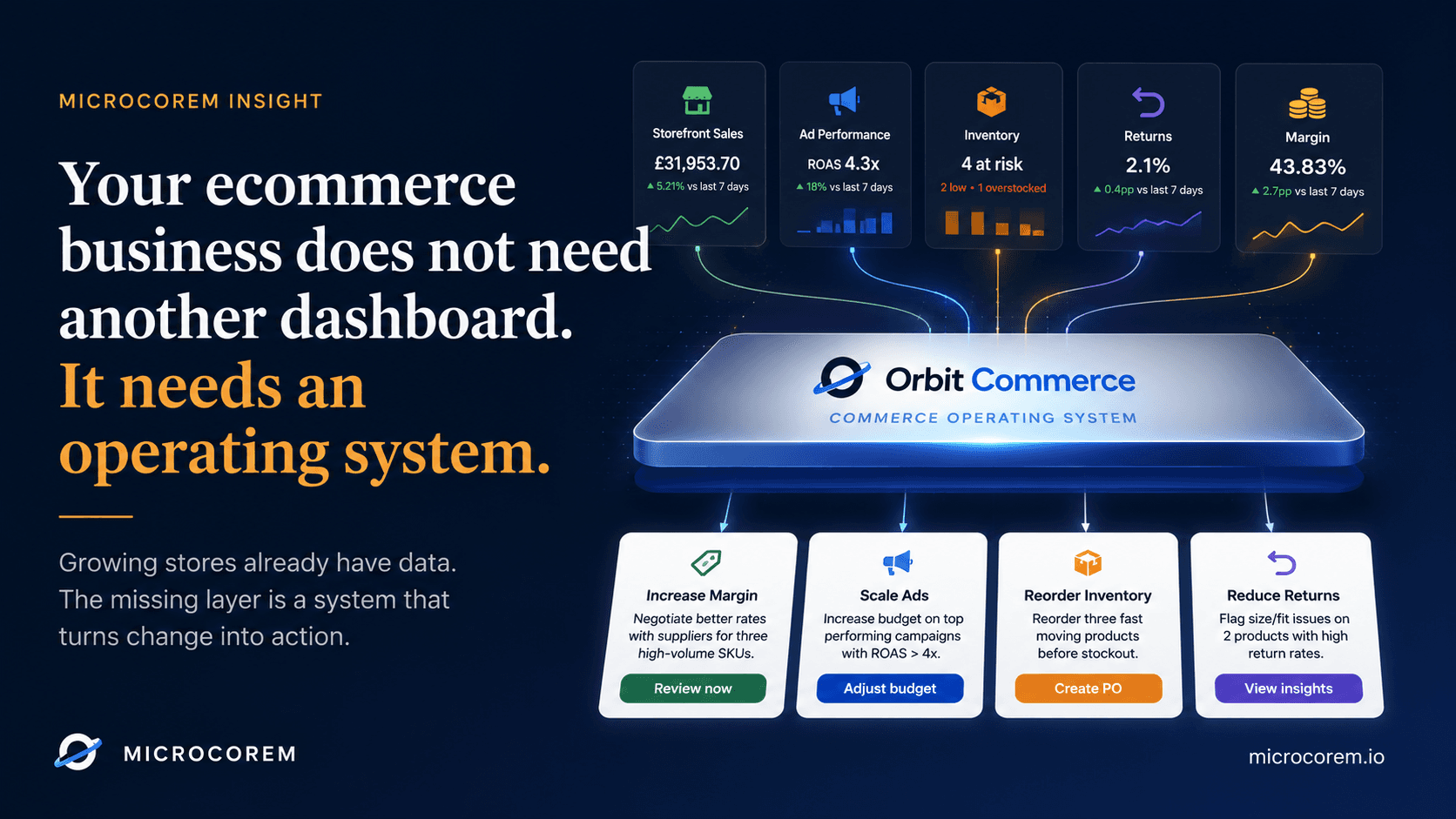
A commerce operating layer connects sales, margin, inventory, returns, advertising and operational work. It does not replace every platform. It gives the business a shared place where important signals can become priorities, owners, approvals and actions.
If a campaign is performing well and stock is low, the useful action may be to reorder inventory before scaling spend. If contribution margin changes, the system should help the team investigate discounting, supplier costs, shipping cost or product mix. If returns rise on two products, the next step may be a product-page review, a sizing check or a supplier conversation.
The value is not that the system knows everything. The value is that it reduces the distance between noticing a change and responding to it.
Where Orbit Commerce fits
Orbit Commerce is one concrete example of the kind of connected operational system Microcorem can design and build. It brings commerce signals into one operating surface and turns them into decisions such as reviewing margin, adjusting advertising budget, creating purchase orders and investigating returns.
That architecture matters because ecommerce teams rarely need a generic platform imposed on top of their business. They need software shaped around how their stock, campaigns, finance checks, approvals and fulfilment actually work.
For a smaller store, a founder or operations lead may hold that context personally. As order volume, channels, products and team size grow, that memory becomes too fragile. The work needs to be captured in a system the whole team can trust.
Microcorem helps businesses design and build this kind of tailored software: connected to existing tools, specific to the operating model, and practical enough for daily use.
The valuable system is not the one that shows you another chart. It is the one that helps your team decide what to do next.