

The best systems do not constantly remind us that they exist. They create space for the work—and the life—that matters.
There is almost nothing technological about this scene.
Sunlight falls across white stone. A woven basket holds fresh figs beneath a loose cloth. A few pieces of fruit rest nearby.
Nothing appears complicated.
That is precisely what makes it an interesting way to think about technology.
Businesses often describe transformation in terms of what they are adding:
more applications
more dashboards
more integrations
more automation
more AI
But some of the most valuable systems are valuable because of what they remove.
They remove searching.
They remove repetitive data entry.
They remove unnecessary hand-offs.
They remove the need to open five applications before answering one question.
They remove waiting for information that already exists somewhere inside the organisation.
And, increasingly, they can remove routine analytical work before a person needs to make a decision.
The end result should not feel like more technology.
It should feel like less friction.
Complexity should live behind the experience
Consider a sales manager trying to answer a simple question:
Which customers require attention today?
Without a connected operating system, that question might involve:
checking the CRM
opening analytics
looking through recent emails
reviewing customer support activity
checking outstanding invoices
searching for account changes
asking colleagues for context
and finally deciding what matters.
The business already possesses most of the information.
The problem is that the person has to assemble it manually.
A better architecture changes the sequence.
Instead of:
Person → application → spreadsheet → another application → colleague → report → decision
we can move toward:
Data → context → signal → decision
Behind that shorter experience there may actually be considerably more engineering.
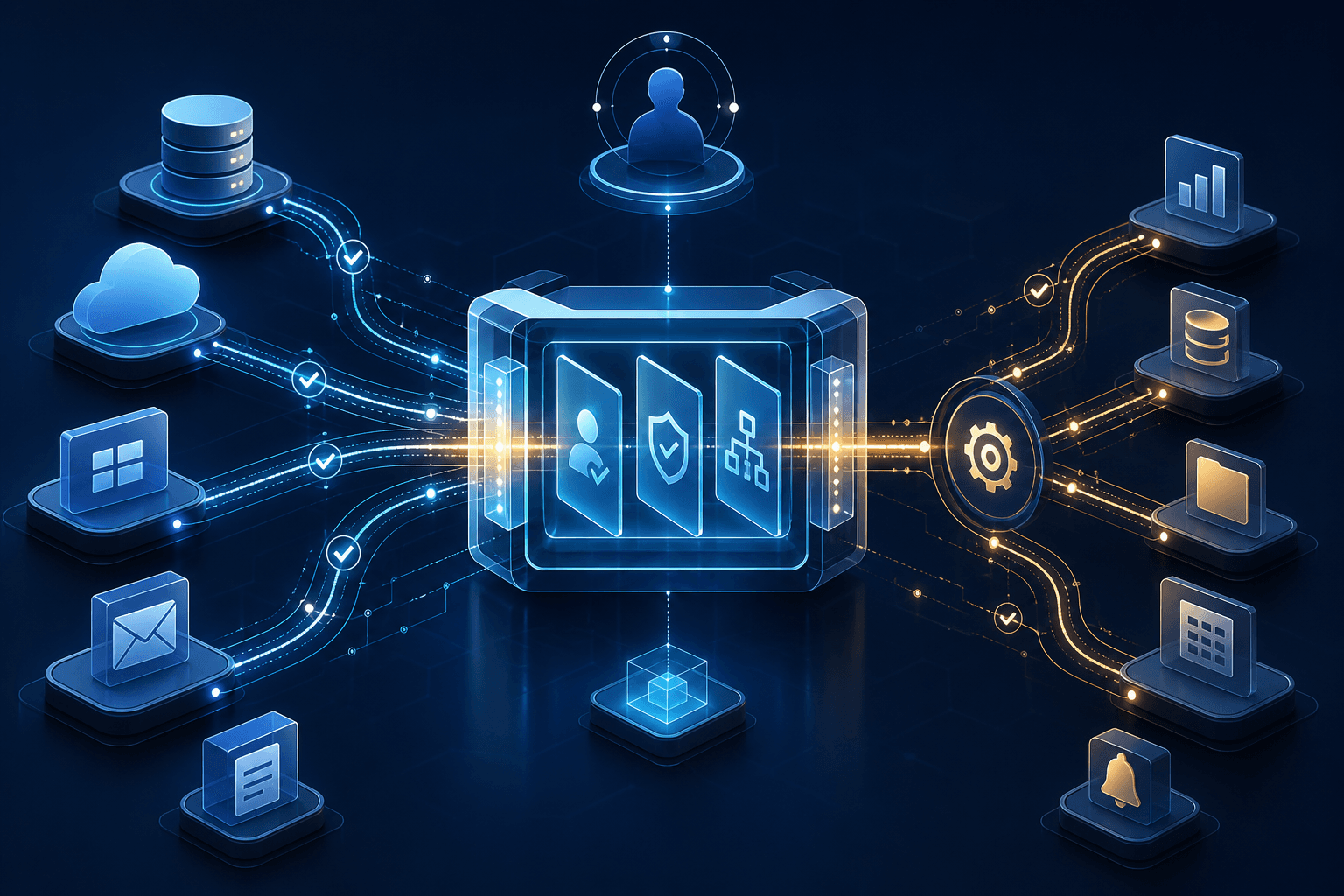
APIs exchange information.
Data pipelines validate records.
Events update systems.
AI models classify or summarise information.
Business rules determine thresholds.
Permissions decide what may happen automatically.
Observability records what changed.
But the person using the system sees something simpler:
This account has changed.
Here is the relevant context.
Here is why it matters.
Here is the action that may now require your judgement.
That is good systems design.
Measure the work the system removes
One useful way of evaluating automation is not simply to count features.
Measure the work that disappears.
Suppose:
Tₘ = time required to complete a workflow manually
Tₐ = human time required after appropriate automation
Then:
ΔT = Tₘ − Tₐ
is the human capacity recovered from that workflow.
Across one task, the improvement may appear small.
Across thousands of repeated operations, it can become commercially significant.
But time is only one dimension.
A business should also examine:
✓ how many systems a person must touch ✓ how many manual hand-offs occur ✓ how often information must be re-entered ✓ how long a decision waits for context
The objective is not to remove people from every process.
It is to remove unnecessary work from the process.
AI should prepare decisions, not merely generate output
This distinction becomes particularly important with AI.
A weak implementation adds another interface:
Employee → AI application → copy result → check another system → correct result → enter data elsewhere
The AI has technically been introduced.
The workflow has not necessarily improved.
A stronger system uses AI inside the operating architecture.
Observe
→ Interpret
→ Prepare
→ Recommend
→ Escalate when required
→ Measure the outcome
For example, an AI-enabled customer system might monitor changes across CRM, support and commercial records.
Instead of requiring an account manager to search everything manually, the system could prepare a short decision packet:
Customer activity has fallen 32%.
Two unresolved support cases remain open.
The contract renews in 45 days.
The account has not had a senior interaction in 60 days.
Recommended action: human review.
The system has not replaced the account manager.
It has removed much of the work required before the account manager can exercise judgement.
That distinction matters.
Operational friction has a cost
We can describe operational friction conceptually as:
Operational Friction = Repetition + Searching + Waiting + Hand-offs + Rework
Every unnecessary interaction has a cost.
Sometimes that cost is visible as payroll.
Sometimes it appears as slower customer response.
Sometimes it appears as an opportunity that was noticed too late.
Sometimes it becomes an employee spending two hours assembling information instead of making a decision.
Technology creates value when it systematically reduces those costs.
The best systems surface exceptions
A mature operating system should not force people to inspect everything.
It should identify what has changed.
Consider finance.
Instead of manually examining every transaction:
System monitors transactions
→ normal activity continues automatically
→ anomaly detected
→ evidence assembled
→ finance team reviews exception
Or operations:
Orders flow normally
→ delivery threshold breached
→ affected customers identified
→ likely cause summarised
→ operations team receives escalation
This is an important principle for AI-enabled business systems:
Humans should increasingly manage exceptions rather than process every routine event.
That is how technology begins to create organisational capacity.
Quiet systems can produce substantial economic value
The most valuable enterprise technology is sometimes almost invisible.
Orders reach the correct system.
Data remains synchronised.
Customers receive consistent information.
Routine events trigger the correct workflows.
Management receives useful signals.
Exceptions surface quickly.
Important decisions can be traced.
Nothing about that sounds as dramatic as a humanoid robot or an autonomous AI demonstration.
But operationally, it can be much more valuable.
The benefits compound:
faster response
less administrative work
fewer avoidable mistakes
shorter decision cycles
more consistent customer service
better visibility
more time for product development
more time for customers
more time for judgement
This is where digital transformation begins to affect the economics of a company.
Not because technology looks impressive.
Because the organisation gains capacity.
Human attention is the scarce resource
We often talk about computing resources:
CPU
memory
tokens
storage
bandwidth
But inside a business, one of the most expensive resources is human attention.
People can only examine a limited number of things carefully in a working day.
A good system therefore protects attention.
Routine information should be processed automatically where appropriate.
Context should be prepared.
Low-risk activity should flow through predefined rules.
Important exceptions should surface with evidence.
Consequential decisions should still reach the person responsible.
The system should therefore optimise not simply for automation.
It should optimise for:
Human Attention → Highest-Value Decisions
That is a more useful design objective.
AI readiness is partly about restraint
There is a temptation to measure AI maturity by how much autonomy an organisation gives its systems.
That is not necessarily the correct measure.
A mature AI system knows where automation should stop.
For example:
An AI system may identify a customer at risk.
It can collect the evidence.
It can summarise the account history.
It can recommend next steps.
It can draft a response.
But a high-value relationship may still justify a human deciding what actually gets sent.
The strongest architectures therefore combine:
automation
context
permissions
confidence thresholds
observability
and human accountability.
The objective is not maximum autonomy.
It is appropriate autonomy.
A simple test for business technology
There is one question worth asking about almost every transformation project:
After we introduce this system, what becomes easier for the person doing the work?
If the answer is unclear, the implementation may not yet be solving the right problem.
Successful technology should make something materially better:
a decision becomes faster
information becomes easier to trust
a repetitive task disappears
a customer receives a quicker response
an exception becomes easier to identify
a person gains time for more valuable work
That is a much stronger measure of transformation than the number of AI tools deployed.
Microcorem Perspective
AI-ready operations should ultimately improve the relationship between people and systems.
We should expect:
Decision latency ↓
Manual intervention ↓
Searching ↓
Duplicated work ↓
Avoidable errors ↓
while:
Information quality ↑
Traceability ↑
Customer responsiveness ↑
Human capacity ↑
The engineering underneath may involve APIs, event-driven systems, data pipelines, AI models, orchestration, permissions and observability.
But the experience above it should become simpler.
That is the paradox of good systems engineering.
The machinery becomes more capable.
The human experience becomes quieter.
The basket does not tell us about the work that brought everything together.
We simply experience the result.
Business technology should aspire to something similar.
The best systems do not constantly remind us that they exist.
They create space for the work—and the life—that matters.
Subsections